Foundation work vs. steel erection: how to read refinery construction stages in imagery
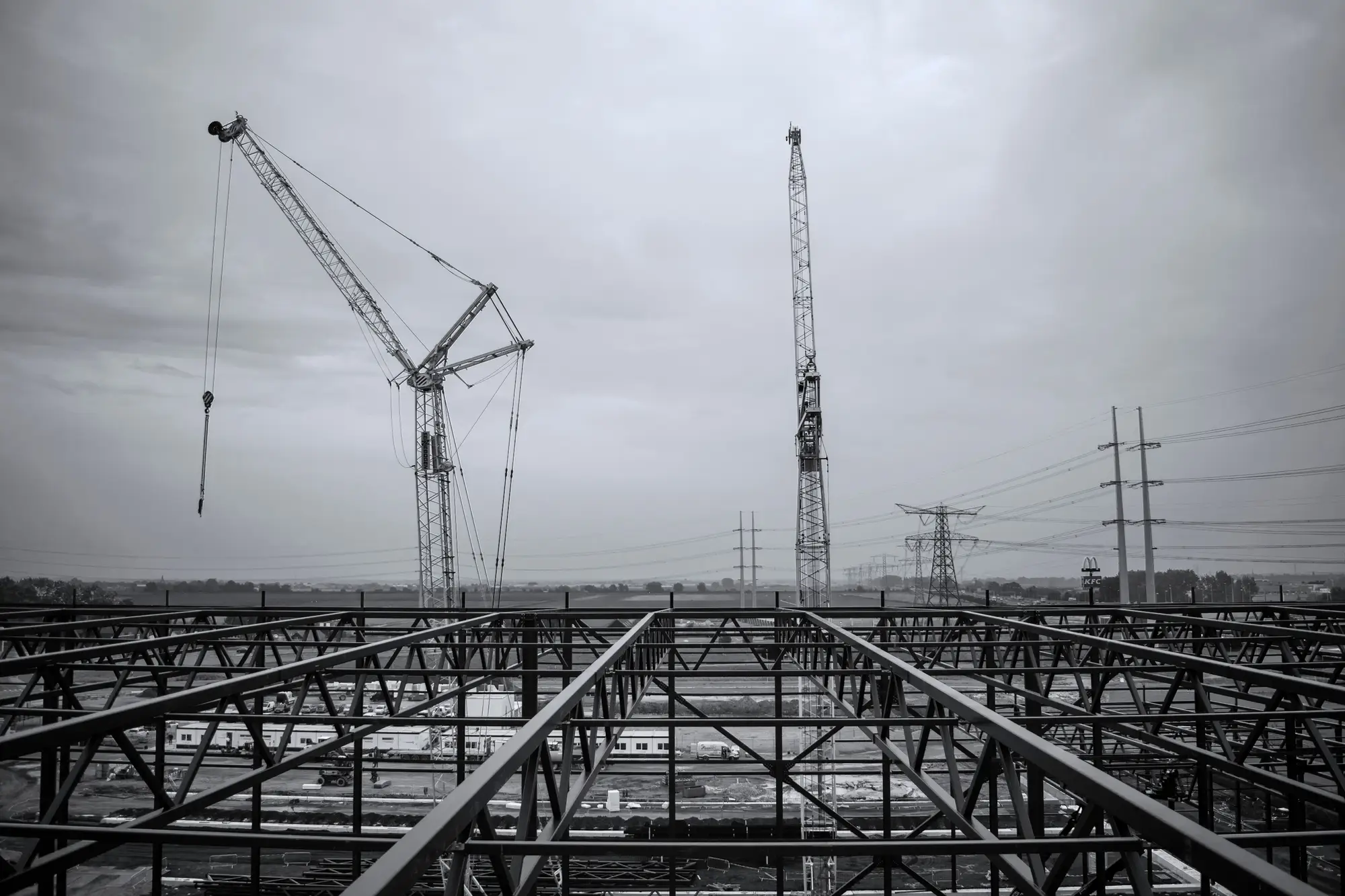
If you're pulling monthly imagery on a refinery or LNG job and trying to figure out whether the site is still pouring concrete or already stacking steel, the tells are more consistent than people expect. Reading the stage correctly comes down to knowing what to look for and in what order it shows up.
What civil and foundation work looks like from above
Early-stage civil work has a flat, excavated, almost raw look. Graded pads sit where equipment foundations will go, often still bare earth or compacted fill with a visible color change from the surrounding ground. Pile caps and mat foundations show up as regular grid patterns, rectangular or circular footprints laid out with engineering precision, usually before anything rises more than a meter off the pad. Rebar cages, when imagery resolution allows, read as a faint crosshatch texture rather than a solid mass.
Look for laydown yards nearby, stacked rebar bundles, concrete batch plants, and a dense scatter of small vehicles and equipment working the grade. Trenching for underground piping and cable runs also shows up here as long linear scars across the site, usually before any vertical structure appears. If you're comparing two monthly passes and the footprint hasn't changed shape but the ground texture within it has gone from bare to poured, that's foundation work progressing, not steel.
What structural steel erection looks like
Steel erection changes the shadow pattern more than anything else. Once columns and beams start going up, you get long, thin shadows cast across the pad that weren't there before, shifting with sun angle month to month. The footprint that was flat in the prior pass now has a skeletal grid visible from above, straight lines crossing at regular intervals, with gaps where decking or cladding hasn't gone in yet.
Cranes are the other giveaway. A tower crane or large mobile crane parked inside or adjacent to a foundation footprint, especially one that wasn't there the previous month, almost always means steel or module placement is underway. Module-based construction (common on LNG trains) shows this even more clearly: large rectangular blocks appear that weren't part of the original foundation footprint, often trucked or barged in as pre-assembled units and set in place in a single pass between imagery dates.
Why the sequence matters for tracking progress
The order matters because civil and foundation work is where schedules quietly slip. A pad that's still graded three months after the EPC's schedule said foundations would be complete is a real signal, regardless of what the contractor's own progress report says. Steel erection, once it starts, tends to move faster and more visibly, which is exactly why relying only on milestone percentages from the contractor's schedule can mask an early-stage delay that doesn't show up until steel should have started and hasn't.
This is the gap that Refinery Progress is built to close: monthly VHR imagery read for module placement and structure growth against the planned startup date, giving traders, lenders, and EPC counterparties an outside-the-fence read that doesn't depend on whoever's writing the internal progress report.
A few things that trip people up
Scaffolding looks a lot like early steel from above, especially on brownfield units where tie-ins happen inside existing structures. Piling rigs can also be mistaken for cranes doing erection work, so check whether the footprint underneath is still bare ground (piling) or already has a poured mat (erection). Partial module sets, where a block has landed but hasn't been bolted or welded into the adjacent structure yet, can sit for a month or two looking "done" when the connecting steel hasn't actually gone in. Comparing against the prior month's pass, not just the current one, is what catches that.
If you're tracking a startup date and want a monthly read that separates "pad poured" from "steel up" without waiting on someone else's schedule update, that's the gap worth closing first.